
For homework for the second day, students need to finish their Childhood Learning Moments Timeline. I start my class slides with a Winston Weathers’ 1984 definition: “The crot is an obsolete word meaning a “bit’ or ‘fragment, ‘ the crot may range from one sentence to twenty or thirty . . .It is fundamentally an autonomous unit, characterized by the absence of any transitional devices” (136). Then we discuss Melinda Putz’s short article “The Crot.” Putz definition: “A crot could be a single sentence, a quotation, a proverb, a list…, a description of a scene, a dialogue, a poem.” Then we discuss Sherman Alexie’s “Unauthorized Biography of Me,” which is a crot essay. Students are put in groups of 3-4, and each group is assigned a specific page of the article. Students are given about 10-15 minutes to count the crots and decide what genre or type of writing each crot is on their assigned page. I answer questions about what I mean by genre or types of writing and remind them there is a double-space between each crot as they work together. I love seeing the lightbulbs come on. Then each group shares its findings with the class.
For instance, on the first page of the Alexie piece, there is a short bio about the author, which I bring to students’ attention. Then the first crot is a scene about Indian boys playing basketball until it’s too dark. The next crot is a thesis statement about Alexie stating he has “never met a Native American” but has “met thousands of Indians” (46). The next crot is some dialogue between Alexie and a person in the audience on why he refers to himself as an Indian. The last crot of this page is the beginning of a seven-paragraph narrative with some dialogue. The first group would tell the class there are five crots in five different genres on the first page. Each group presents their count of crots and genres to the class. By the time we go through all seven pages, the students get the idea about what a crot is, a specific type of writing such as an anecdote, scene, thesis, lists, formula, narrative, dialogue, description, lists, and even a bio of the author. They can also see that all of the crots are separated by a double white space, with no transitions. I bring to their attention that the thread or connection that holds them all together is that the crots are about Sherman Alexie. This is reflected in the title “Unauthorized Biography of Me,” just as the title of the assignment is “Who Am I?” As a first assignment, this crot essay gives me information and insight about my students.
At the end of the second class, I have students make a copy of the auto-bio poem form (see below) in our shared folder and navigate it to their Project 1 folder shared with me in Google Drive. This could also be a hard copy for students to fill out. Students have to fill in the blanks in the form with words that describe themselves. Then they use the phrases and answers to create their auto-bio poem (student example below). This poem counts as one of their 10 childhood learning moments for a first draft due for the next class.


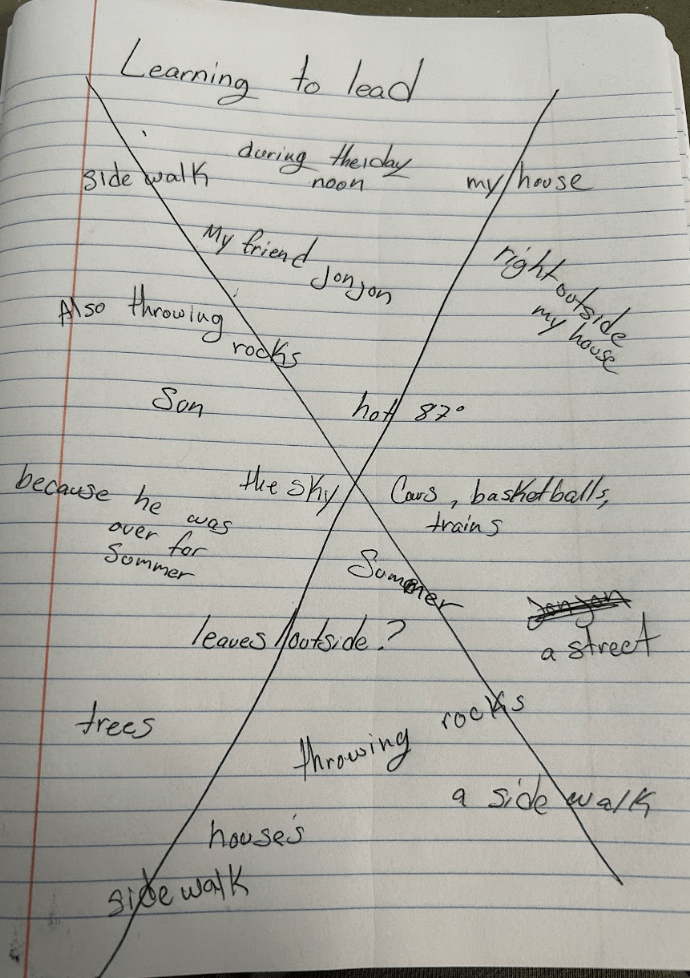
At the beginning of the third class, to help students with their 4-6 paragraph narratives, I have them do Lynda Barry’s X-page activity from Syllabus (79-81). Students open their composition books or notebooks to a blank page and draw a big X across the page. I have them put the title of the childhood learning moment at the top of the page. Then, as I read the 20 questions out loud, students write their answers anywhere on the X-page. Questions such as: Where are you? What are you doing? What season is it? Where is the light coming from? Who else is there? Etc. (student example right)
After students have answered all of the questions, I tell them to revise this learning moment using their answers to expand the narrative into 4-6 paragraphs with some dialogue. When I assess the crot essay assignment, it is easy to see if they have revised by adding their X-page answers, telling me where they are, the season it is, where the light is coming from, who is with them, etc. Here’s a Crot essay Student Example with my comments.
Also on the third day, students create a 3-panel comic about the X-page Narrative. The reading assignment for this class is the first 11 pages of Scott McCloud’s chapter one, “Writing With Pictures,” from Making Comics. In my next post, I will explain this activity and include examples.

 Cunniforms to Blinking Cursors